Project Open-ATLAS builds open datasets with a traceable origin on every record.
The problem
Models are only as trustworthy as their data, and much open training data has unclear origins, unclear licences and fields nobody verified.
Our principles
Provenance is mandatory. No fabricated fields. Ground-truth labels only, assigned before any model sees the data. The licence is tracked per record from the first record. Text used for benchmark comparison stays byte-identical to its source.
Theo
Theo is the text release of Project Open-ATLAS: an open engineering assistant, published as a dataset on Hugging Face on 13 November 2026. It teaches small models to call deterministic tools instead of guessing, to ask when a value is missing, to report assumptions and warnings, and to refuse requests that would defeat safety protections. It is licensed CC BY 4.0.
| Subset | Topic | Records | Train / validation / test |
|---|---|---|---|
| ev | Electric vehicles | 15,000 | 13,000 / 1,000 / 1,000 |
| humanoid | Humanoid robots | 6,349 | 5,104 / 614 / 631 |
| code | Engineering code | 15,000 | 13,000 / 1,000 / 1,000 |
| Total | 36,349 | 124 MB, English text |
What is in a record
Each record is a conversation with tool calls and tool results. Record types include calculations, clarifying questions, code, concept explanations, critiques, documents, flags for unsafe or inconsistent inputs, refusals, simulations and multi-tool chains. The electric-vehicle tools cover unit checks, pack sizing, range, motor torque, gear ratio, charge time, and battery, longitudinal-dynamics and thermal simulations. The humanoid tools cover joint torque, actuator selection, centre of mass and zero-moment point, and battery runtime.
How it was made
Scenarios are sampled with realistic inputs, real tools are run to produce the calls and results, and answers are composed from hand-written fragments. Code records were executed in a sandbox, and every record is verified by code. Validation and test sets hold out whole user phrasings.
Limits
- Wording is template-based, so it is narrower than natural user text.
- Outputs are first-pass estimates, not design sign-off.
- The humanoid subset has no simulation, code, document or critique records.
- Refusal examples cover requests to defeat protections such as battery protection, interlocks and emergency stops. They give no procedure and offer a safe alternative.
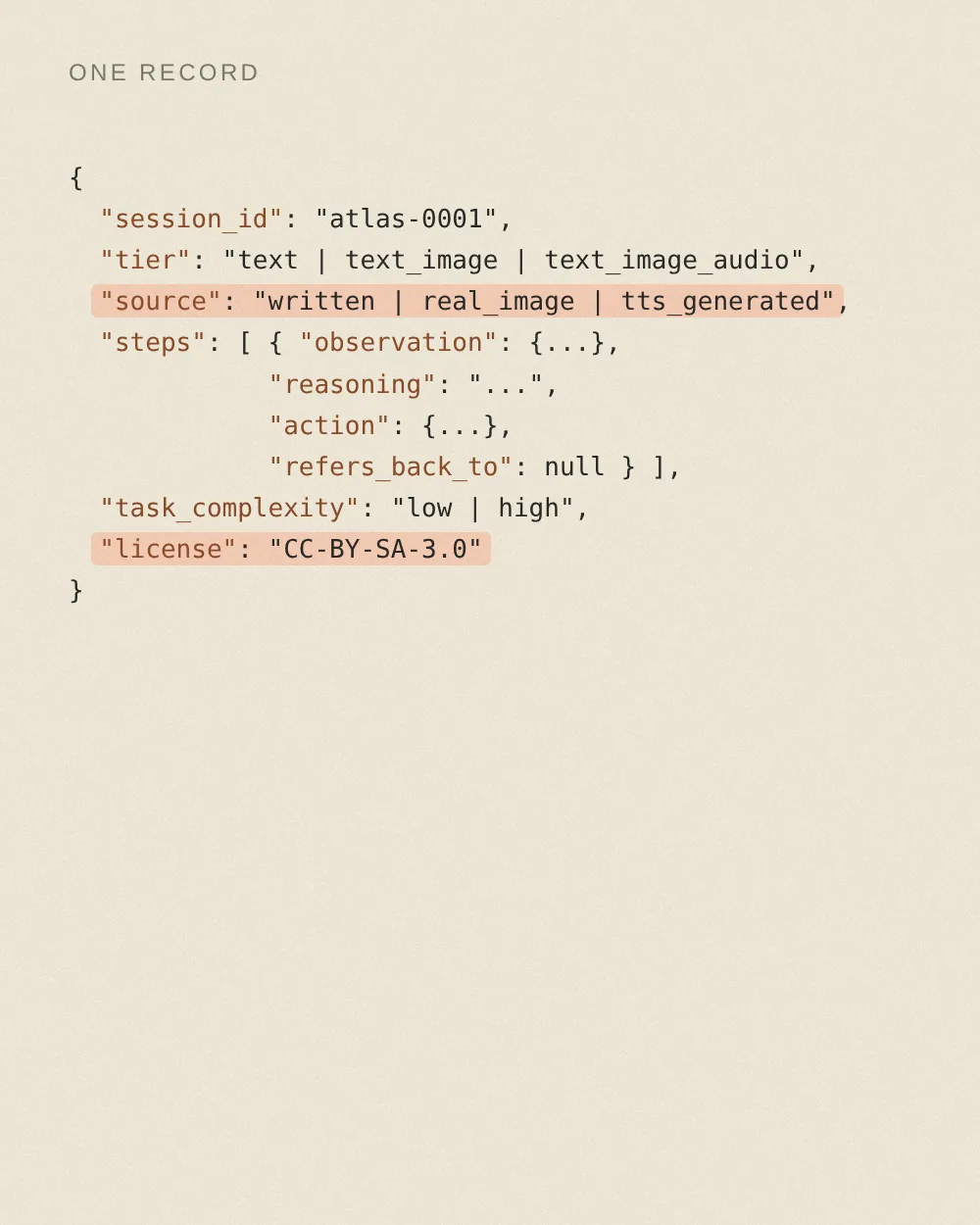
The Open-ATLAS record format
Open-ATLAS (Openwist's Audio, Text and Lateral Analysis Sets) is designed to cover text, text with images, and later audio, organised as long multi-turn reasoning sessions rather than isolated question and answer pairs. It does not include physical control data or robot actuation. This format is in design.
{
  "session_id": "atlas-0001",
  "tier": "text | text_image | text_image_audio",
  "source": "written | real_image | tts_generated | real_recording",
  "steps": [ { "observation": {...}, "reasoning": "...",
               "action": {...}, "refers_back_to": null } ],
  "task_complexity": "low | high",
  "license": "CC-BY-SA-3.0"
}
- Tier 1Text sessions with reasoning traces that refer back to earlier turns
- Tier 2Text with real, licensed images and multi-step visual reasoning
- Tier 3Text, images and audio, from real recordings or clearly labelled speech synthesis
1 article
Nothing here yet.