Project Cortex is an architecture for machines that have to reason and act in the real world.
The problem
Robots and vehicles perceive continuously, must remember what they have seen, decide quickly on limited hardware, and keep learning without forgetting. Today those needs are usually met by separate pieces that are hard to inspect and hard to trust.
Our approach
One architecture built from separate parts for each of those jobs, so its behaviour is easier to reason about, test and explain. Cortex combines liquid time-constant networks, state-space layers, Hopfield-style associative memory, and continual learning with elastic weight consolidation and replay.
First results
Our research paper, published in July 2026, reports three of the five experiments we have planned. Each one tests a single component on its own. The paper and its charts use the project's earlier name, NEXUS-1.
Memory: EXP-002
A modern Hopfield memory kept recall at 1.000 up to 800 stored patterns at 128 dimensions with 10 percent noise, while a classical Hopfield memory failed at around 25 patterns. At 64 dimensions, recall at 800 patterns was 0.88. We did not find a capacity limit at 128 dimensions or more. The test used random patterns, so real data may behave differently.
Fast control: EXP-004b
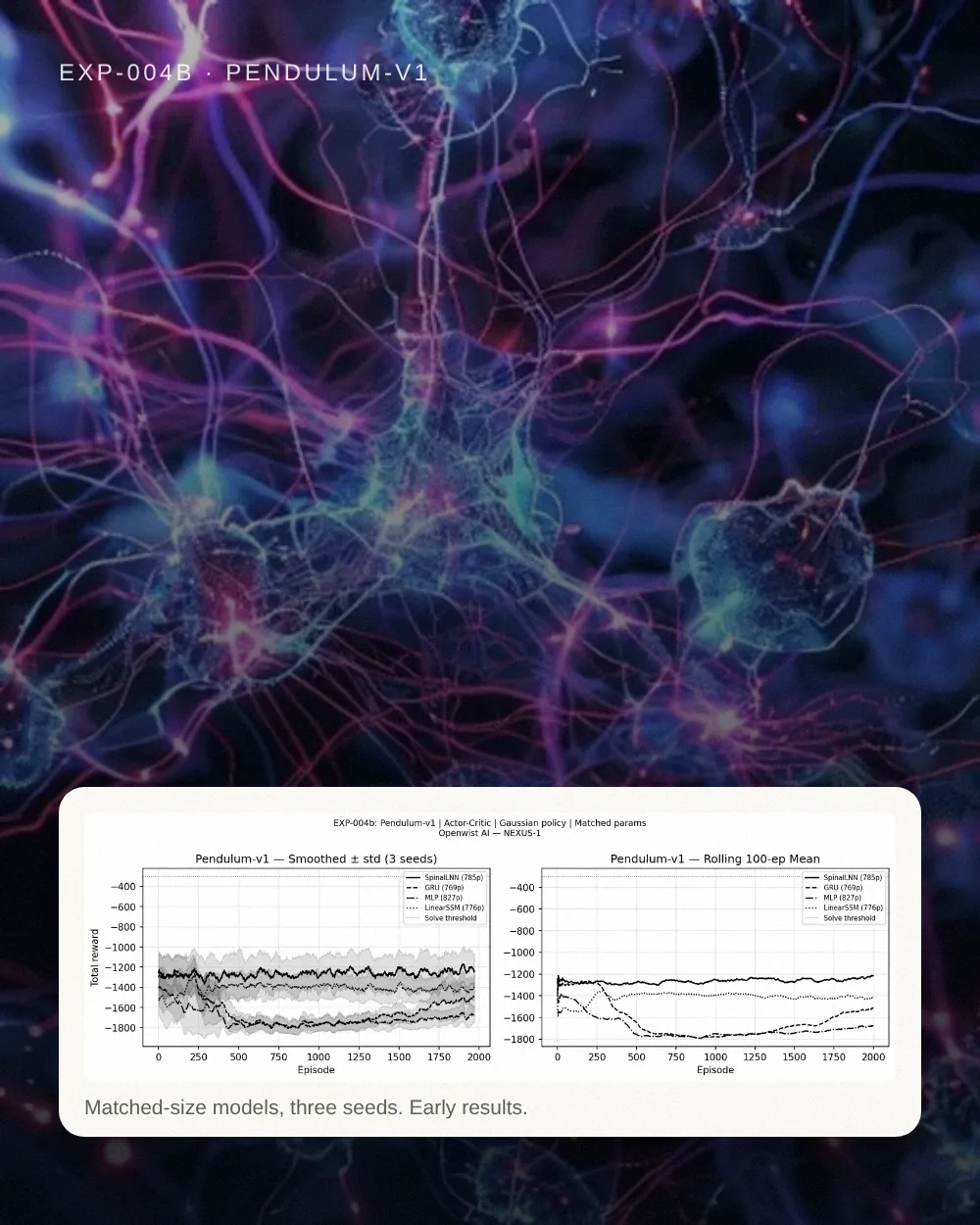
Four small models with matched parameter counts (769 to 827) were compared on two control tasks, using three random seeds. Our fast-reflex model, SpinalLNN, ran in 0.7 ms per step on a CPU.
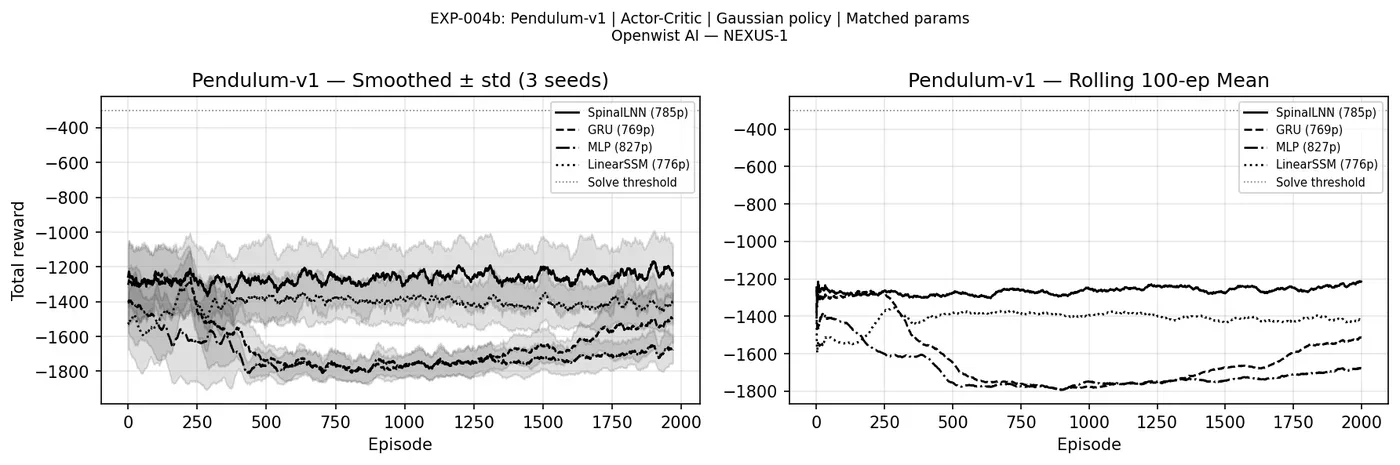
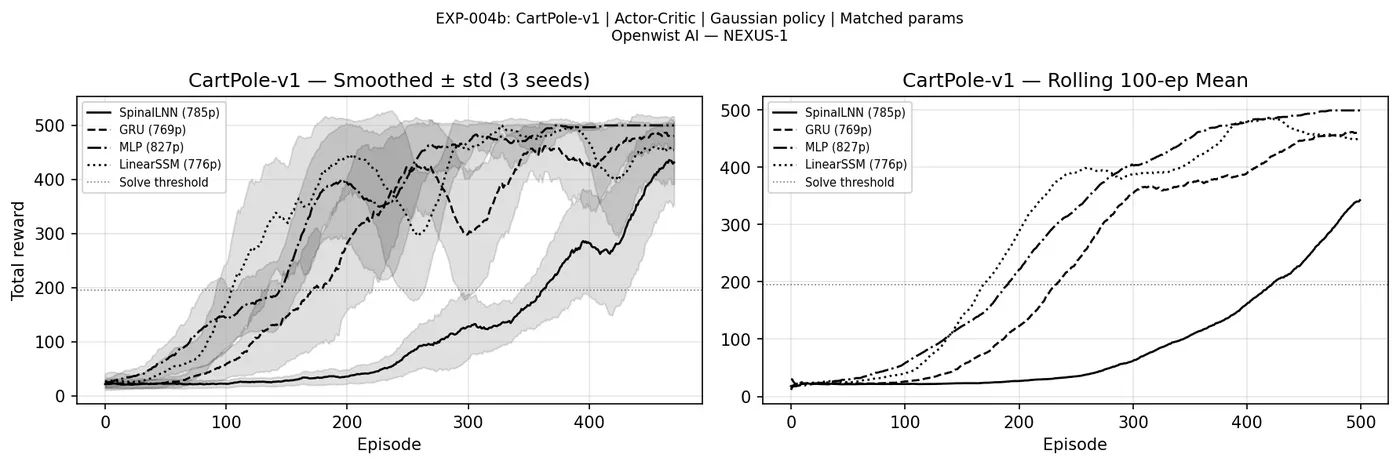
The results are mixed. SpinalLNN did best on continuous control and worst on the simpler discrete task.
Continual learning: EXP-005
A network trained on MNIST and then on Fashion-MNIST kept 28.4 percent of its first-task accuracy with no protection, and 98.1 percent with replay and elastic weight consolidation together. Replay alone kept 97.4 percent and elastic weight consolidation alone kept 54.6 percent, so in this test replay did nearly all of the work. Learning the second task was not harmed.
What we do not know yet
- These are small models, three seeds and a small number of tasks. The continual-learning test used two tasks and a replay buffer that held 2,000 of 60,000 training images.
- The two remaining experiments, a language-modelling comparison against a transformer and a test of the predictive-coding layers, need GPU time and have not been run.
- We have not yet evaluated the full architecture end to end, or tested it in full physics simulators for humanoid or vehicle control.
Long context on small memory
We also want language models that run in very little memory and can follow very long inputs. A standard transformer keeps a record of every earlier token, so its memory use grows with the length of the text. A state-space layer keeps a fixed-size state instead, so its memory use does not grow with length. That is why Cortex uses state-space layers for long sequences.
- Built so far: Modelfile Lint and the VS Code extension estimate the memory a model needs, including its context cache, and find the largest context that fits on a given machine.
- Not yet tested: we have not trained or measured a language model of our own for long context or low memory, and we do not claim unlimited context. We will publish results here when we have them, including the ones that disappoint.
1 article
Nothing here yet.